TLS Certificates, Explained Through a GTA 6 Leak

This is not AI content, so there is no gaslighting here.
In August 2026, X.com was shaken by a leaked video of GTA 6. GTA 6 teaser hadn’t been published yet. However, the spoiler is not the big thing. In the video, the player spelled their name in bullets.
- People hadn’t played GTA 6 before but everyone understood it was GTA 6.
- The hacker proved they can play GTA 6 by doing arbitrary actions in the game.
Let’s abstract this mechanism. You can test whether something is derived from something else. You can say if a video is from GTA 6.
You cannot create a derivative from something else. You cannot create a video from GTA 6 without playing it.
So, if you see a person who can create arbitrary derivatives, then you can believe they are the owner. This is the key idea behind certificates.
To integrate this mechanism into code, we can write some pseudo code like below.
Signature sign(Owner owner);
boolean verify(Owner owner, Signature signature);
The sign() function returns a Signature object by taking an owner. Once you have the Signature object, you can ask ‘Is this person the owner of the signature?’ by using the verify() function.
Assume you have a friend. Your friend is the only person who have sign() function and everyone have verify() function. To prove somebody is your friend, you can request the signature then verify the signature belongs to your friend.
However, what happens if someone steal the signature? If your friend gave you this signature, then technically you can share it with everyone and everyone else can too. We have to create specialized signatures for everyone.
Signature sign(Owner owner, String payload);
boolean verify(Owner owner, Signature signature, String payload);
Now, your friend can put an arbitrary payload into the signature. When somebody wants to prove they have a working sign() function, request a signature with your own arbitrary random payload. All you need is to verify this signature is owned by your friend and it is the payload that you made up.
Being convinced the server is genuine
We defined imaginary functions and objects to understand the mechanism. Now let’s map them to the real implementation.
- sign() function: Signing a payload with the private key.
- verify() function: The public key.
- Owner objects: Abstract identification of entities. (Server in our case.)
Some genius mathematicians introduced mathematical functions to implement our imaginary sign and verify functions. I really respect them. They introduced private key and public key pairs. Under the hood, they are just numbers.
You can transform any payload using your private key and your public key can verify this transformation was done by exactly its private key. We call this transformation ‘signing’ and we call the transformed payload ‘signature’.
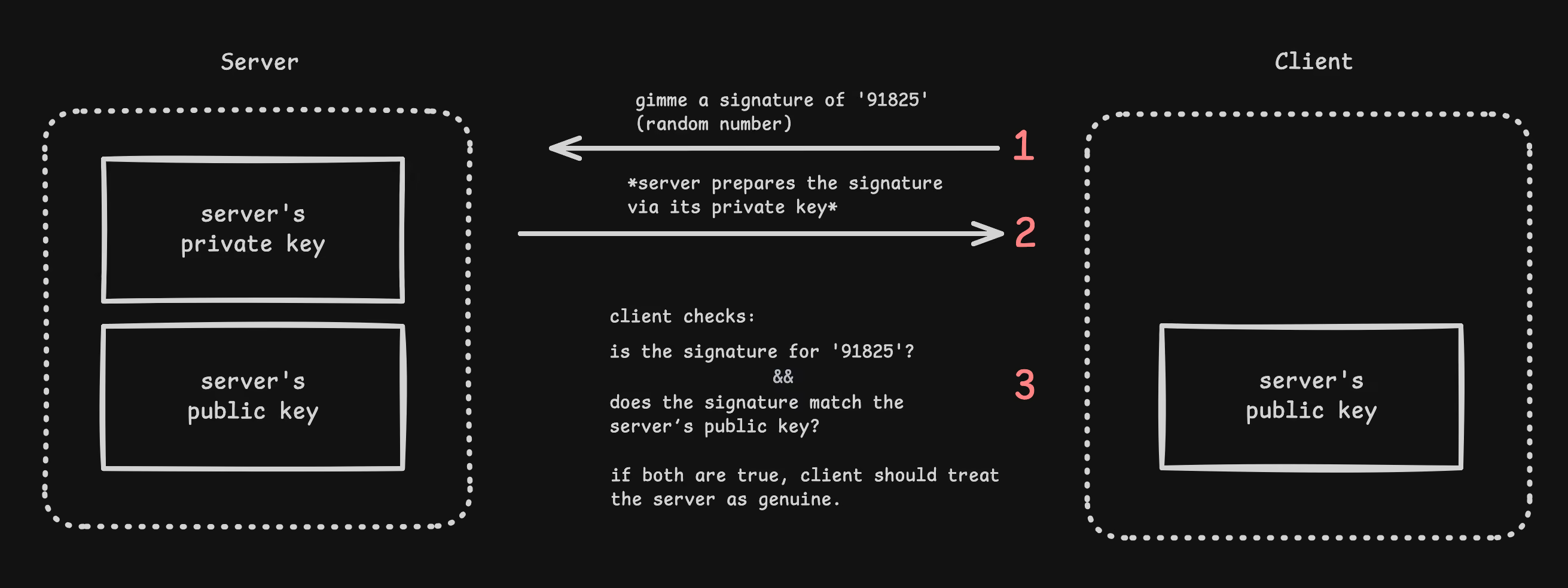
Now the server can prove itself to any client, without having to trust them to keep its signature secret.
However, there is a very big problem here. I told you everyone has the verify() function therefore, the client in the diagram contains server’s public key. However in practice it means all servers we want to communicate with, have to serve their public keys to all possible clients. Even if we do that, the client still needs to know that the public key it received comes from trusted services. We just reintroduced same problem while solving it.
How can the client be sure the public key it has is the right one?
Meet the certificates. Certificates unlock vouching from one entity to another. A certificate is just another signature that basically says ‘public key of that host is that’. To handle countless entities’ public keys we just link them to a central entity. If a trusted entity vouches that this public key belongs to this host, I can believe it. Therefore, I can store only the central entities’ public keys. It is the key idea of the solution.
Today, we call these ‘central entities’ as ‘certificate authorities’. Every program that wants to use TLS protocol uses a predefined, built-in set of public keys of certificate authorities.
When you vouch for millions of certificates, the risk of leaking your private key becomes unacceptable. Besides, signing certificates means you have to use your private key many times which also increases possibility of a leak. That is our next problem.
Extreme Paranoia of Certificate Authorities
Imagine, you have entered your bank’s website. No UI difference, no warnings, no domain typo. There is nothing suspicious. You enter your login password.
Minutes later, all your money is used to purchase Bitcoin. You didn’t do anything wrong. The worst thing is, you are not an exception. Now, imagine government websites, military related services, e-commerce websites, search engines, social media and many more. Everybody would stop trusting websites.
Leaking a private key that signs millions of certificates trusted by millions would be a disaster. It is almost more important than my Steam account.
Firstly, nobody uses these private keys directly as they want. When you’ve purchased a certificate, your certificate will be signed by an ‘intermediate certificate’ which is signed by a ‘root certificate’. So, the root certificate’s private key is stored offline and used rarely. There are many intermediate certificates. Intermediate certificates are easy to invalidate because the programs’ built-in stores keep root certificate not intermediate ones.
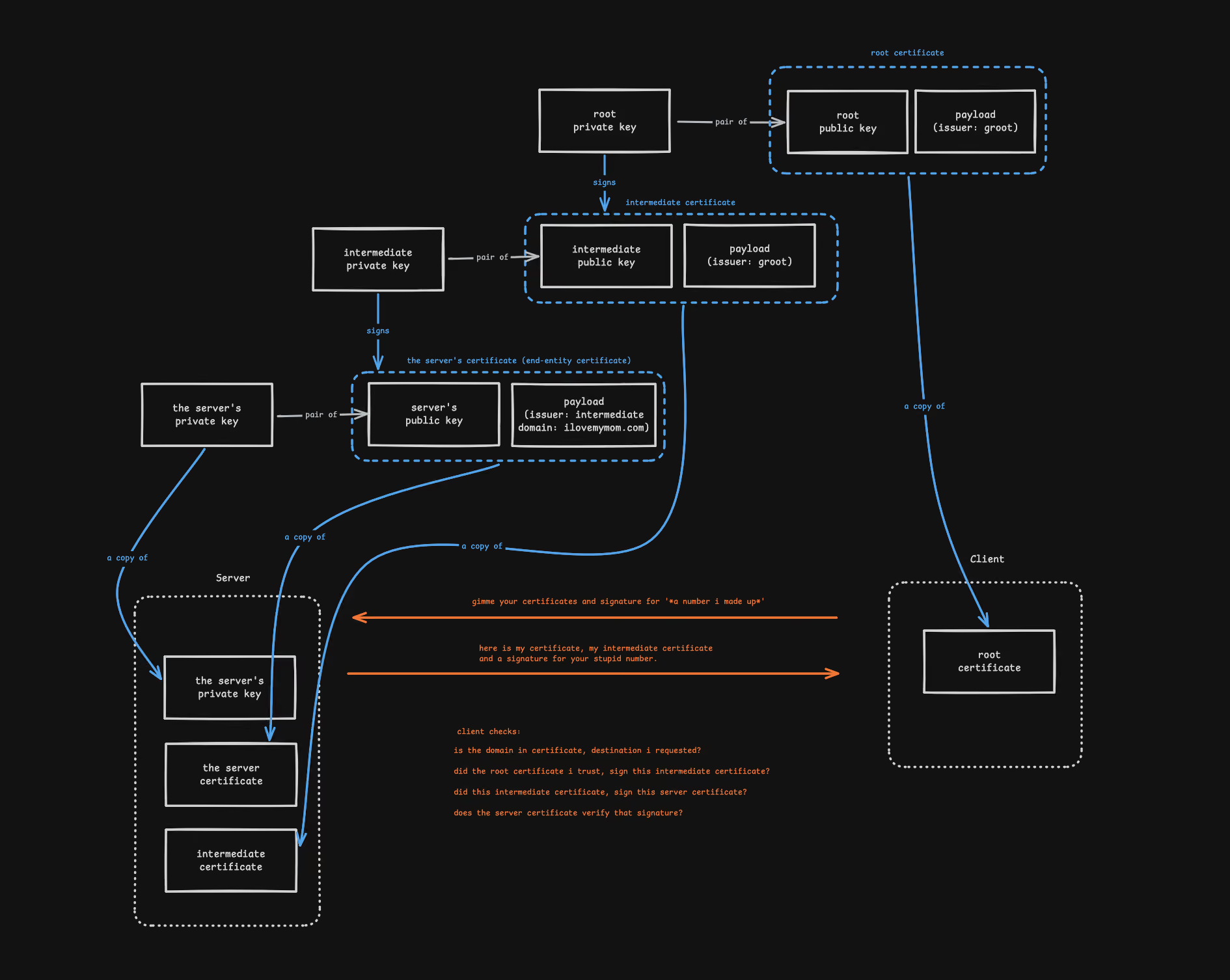
This is the full picture of how certificates typically work.
If an intermediate certificate’s private key got leaked, then we just tell everyone this certificate is no longer trusted. This affects a smaller part of websites. The untrusted certificates list is called a ‘Certificate revocation list’.
The root certificate’s private key is stored offline and generated via very specific and strict procedures. This process is called ‘key ceremony’. The root private key is stored in a tamper-resistant offline hardware security module (HSM) in a box in a vault in a cage in a secure room in a secure building. Nobody (including the ceremony admin) can enter the room alone. Any detected tampering operation to the HSM causes zeroization in microseconds.
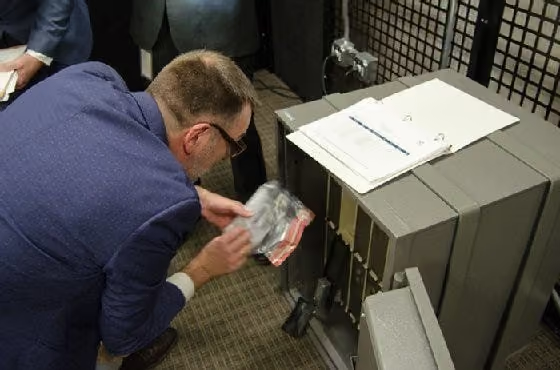 Key Ceremony. Photo: TechTarget
ICANN’s DNSSEC key ceremonies are very cool. The whole process of key ceremony must be recorded and sometimes streamed on YouTube. It is good example that gives an idea of the procedures.
Watch a key ceremony on YouTube
There are ~150 root certificates managed by various certificate authorities. Also, the most important part of the certificate security is logging.
Certificate Transparency
All publicly trusted TLS certificates must be logged when they are signed and shared in public. This mechanism is called ‘certificate transparency’ and described in RFC 6962.
Comodo and DigiNotar were two certificate authorities. Comodo in March 2011 and DigiNotar in June 2011 got hacked within 3 months. In the DigiNotar case, 300,000 unique IP addresses in Iran were affected. After that, Ben Laurie and Adam Langley from Google said “whatta f* ???” ohm. I mean.. They just suggested a mechanism that is known as ‘certificate transparency’. By the way, DigiNotar went bankrupt a month later.
These logs can be discovered on crt.sh.
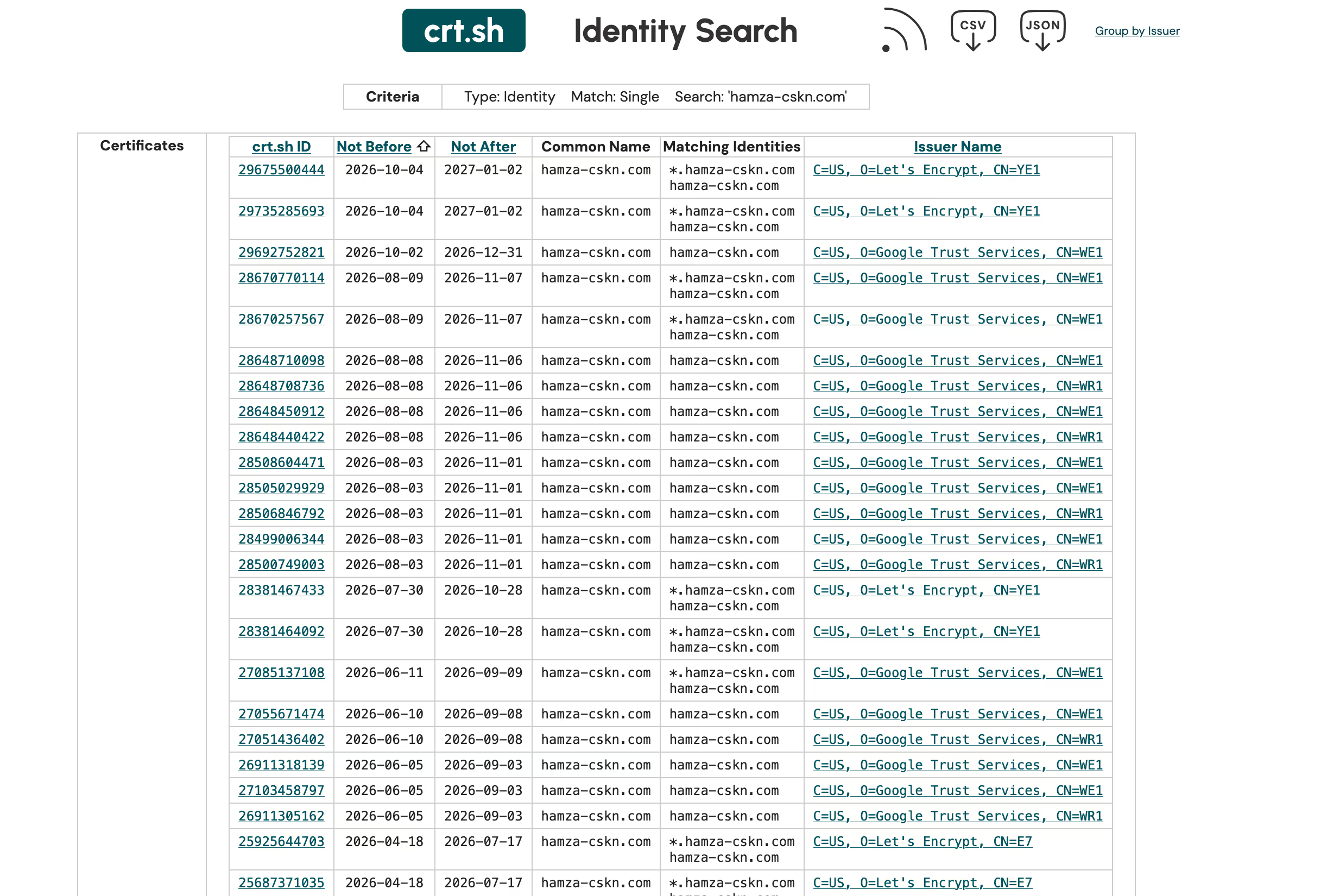 Typical result page of Certificate Transparency logs.